


Carol Ann’s Grilled Skirt Steak with Chimichurri Sauce - An Affordable Yet Delicious Meal


What happened to the price of beef?
When we go to the supermarket or out to eat at a restaurant, the price of a good steak can cause our heads to spin. Beef prices continue to rise, and depending upon the cut of beef we purchase, August 2026 prices are 17 to 24 percent higher than they were in January 2025. In the past when we dined at a nice restaurant, I ordered filet mignon; but, anymore, when I see the $50 or higher price tag, I opt for something less expensive. And the prices at the supermarket, although not as high as a restaurant, also give me sticker shock.
Why are beef prices so high?
Smaller herds. One reason is that US cattle herds are at their lowest level in 75 years. In 2026, the United States had 86.2 million cattle and calves, down from 100.8 million in 2010 and 93.8 million in 2020. This decline is not a recent phenomenon; the nation’s cattle herds have been weakening for decades.
Fewer ranches. There are currently 450,000 fewer cattle ranches today than in 1997. Ranching is not a high-profit business, with 71 percent of ranches operating with less than 10 percent profit. Small family ranches are asset heavy but cash thin and cannot survive rising operating costs, drought, and disease. Many have lost the battle to survive.
Increased costs. Cattle ranchers face the same issues we all face as we watch the cost of everything rise. For them this includes equipment, fuel, insurance, fertilizer, wages, electricity, and water. As the costs of running a ranch have risen, the cost of raising cattle has skyrocketed. In 2025 the cost of raising one head of cattle rose to an unprecedented $1,762 per head.
Drought: Here in Colorado we are experiencing drought. Just in my subdivision, water shortages are preventing our HOA from watering our common areas, which are dying, and many lawns look brown and thirsty. This has affected the cattle industry as well, with 75 percent of the US beef cattle living in drought, compared with a normal of 20 percent. Ranching depends on water, grass, hay, and forage, and these are all negatively impacted by drought.
Disease: A pest called the New World screwworm has been another reason. Screwworm larvae feed on living tissue and can seriously harm livestock. This pest spread throughout the cattle herds in Mexico, forcing the USDA to stop the import of live cattle from this country, which prevented over 1 million Mexican cattle from entering the US market. New World screwworm crossed the southern border into Texas, with 15 confirmed cases now in the United States. Hopefully, this larvae will be contained and not spread further.
Limited processing options. The US has four major meatpacking firms—Tyson, JBS USA, Cargill, and National Beef. These packers control 85 percent of the US cattle market, leaving ranchers with limited processing options. If one of these firms shuts down a facility or changes shift operations, ranchers have limited outlets, weak bargaining power, and a supply chain dependent upon a few large companies.
Is there an answer? Importing beef hasn’t solved the problem. Since it can take two to three years to breed, raise, and rebuild a cattle herd to reach market weight, agricultural economists project elevated beef prices will persist through 2027 and possibly into 2028, so it seems we will have a few more years of rising beef prices.
I usually include information on how to select the main ingredients in my featured recipe at the end of each blog. I read through my information on beef and just couldn’t narrow it down. With beef at over $20 a pound, picking up my Grocery Shopping Secrets book is well worth the $19.95. It has never been more important to be knowledgeable about selecting the very best beef.
If you are craving beef and are like me and don’t want to spend the big bucks, give skirt steak a try. Since skirt steak is a lean cut of meat, purchase Choice or Prime graded beef. If your supermarket sells Select-graded skirt steak, pass.
Skirt steak should be marinated to tenderize it with a marinade that includes both vinegar and citrus. It should be cooked quickly over a high heat to a temperature of 130 to 135 degrees F. It is best served medium rare; overcooked skirt steak will be tough. It is also important to slice skirt steak across the grain.
Carol Ann’s Grilled Skirt Steak with Chimichurri Sauce
Makes 3 to 6 servings
For the skirt steak:
⅓ cup extra virgin olive oil
⅓ cup soy sauce
⅓ cup lime juice
¼ cup balsamic vinegar
2 tablespoons Worcestershire® sauce
1 tablespoon garlic, minced
2 tablespoons brown sugar
½ teaspoon salt
½ teaspoon large grind black pepper
Pinch crushed red pepper flakes
1 to 2 pounds skirt steak
In a blender, place olive oil, soy sauce, lime juice, vinegar, Worcestershire®, garlic, brown sugar, salt, pepper, and crushed red pepper flakes and purée. Place skirt steak in a baking dish and pour marinade over steak. Using a fork, pierce meat so that marinade soaks in. Marinate steak for at least 30 minutes but no longer than 6 hours, turning occasionally and piercing meat with a fork.
Let steak sit at room temperature for 30 minutes before cooking. Preheat the grill to a high heat, 550 degrees F. Remove meat from marinade and grill 2 to 3 minutes per side. Grilling time depends upon thickness of steak. Grill to an internal temperature of 130 to 135 degrees F. Shirt steak should be cooked medium rare.
Place steak on a cutting board and let sit 10 minutes before slicing. Skirt steak must be cut across the grain. The little lines running across the steak is the grain. Position your knife perpendicular to the grain and slice into thin slices.
For the chimichurri sauce:
1 cup fresh cilantro, stems and leaves, packed tightly
1 cup fresh parsley, stems and leaves, packed tightly
2 teaspoons garlic, minced
1 teaspoon crushed red pepper flakes
½ teaspoon dried oregano leaves
½ teaspoon salt
2 tablespoons red wine vinegar
½ cup extra virgin olive oil, plus more if needed
In a blender or food processor, place cilantro, parsley, garlic, red pepper flakes, oregano, salt, red wine vinegar, and olive oil and process to combine. Add additional olive oil if sauce is not the thickness you desire. Let the sauce sit 30 minutes before serving to allow flavors to blend.
To serve: Place chimichurri sauce in a small bowl and serve on the side.
Carol Ann

Carol Ann Kates is the award-winning author of cookbook, Secret Recipes from the Corner Market, and international Amazon best-selling and award-winning author of Grocery Shopping Secrets. She’s an expert in how to shop, select, and store produce for maximizing home cooking outcomes and minimizing time and money spent. As a former supermarket and deli operator, Carol Ann shares grocery-insider wisdom—the same expertise you used to receive when patronizing a mom-and-pop establishment. Contact her at CarolAnn@CarolAnnKates.com and explore her website, www.CarolAnnKates.com.
Copyright 2026 All Rights Reserved Carol Ann Kates
1
Searing the Beef
Sear beef fillets on high heat for 2 minutes per side to form a golden crust. Let it cool before proceeding to keep the beef tender.
1
Searing the Beef
Sear beef fillets on high heat for 2 minutes per side to form a golden crust. Let it cool before proceeding to keep the beef tender.
1
Searing the Beef
Sear beef fillets on high heat for 2 minutes per side to form a golden crust. Let it cool before proceeding to keep the beef tender.
1
Searing the Beef
Sear beef fillets on high heat for 2 minutes per side to form a golden crust. Let it cool before proceeding to keep the beef tender.
Notes


1
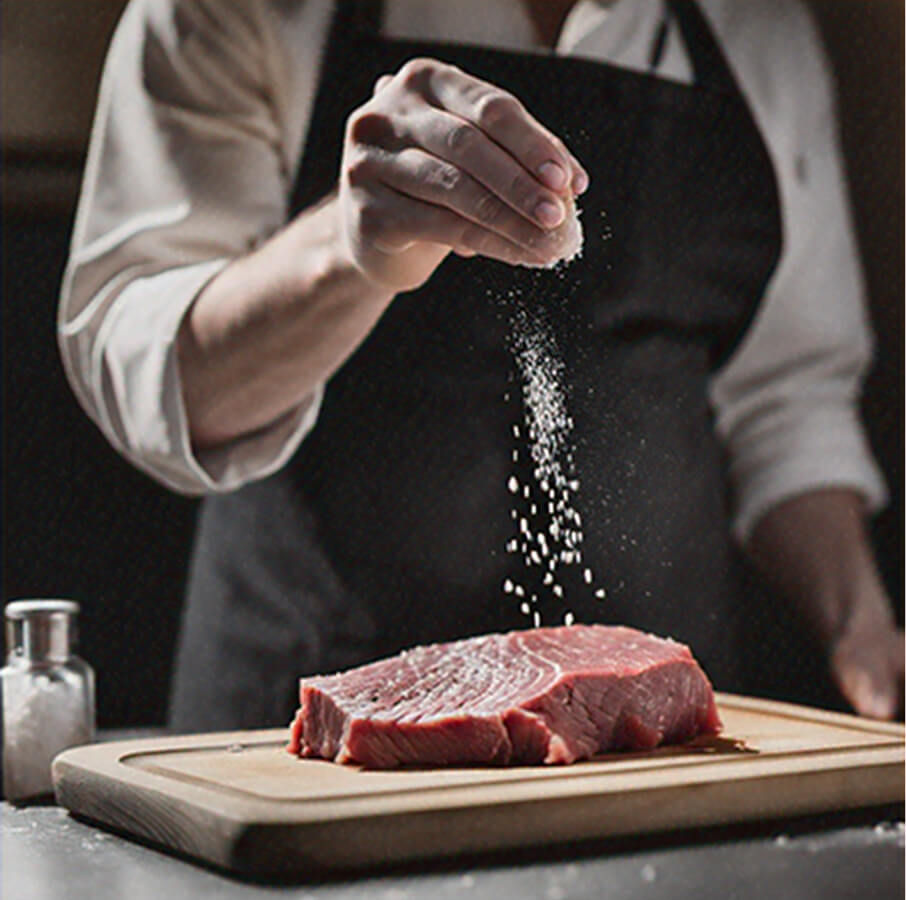
Season the good fresh beef fillets with salt and black pepper. Heat olive oil in a pan over high heat and sear the fillets for 2 minutes per side until it fully browned. Remove the beef from the pan and brush with a thin layer of mustard. Let it cool.
1
Season the good fresh beef fillets with salt and black pepper. Heat olive oil in a pan over high heat and sear the fillets for 2 minutes per side until it fully browned. Remove the beef from the pan and brush with a thin layer of mustard. Let it cool.
1
Season the good fresh beef fillets with salt and black pepper. Heat olive oil in a pan over high heat and sear the fillets for 2 minutes per side until it fully browned. Remove the beef from the pan and brush with a thin layer of mustard. Let it cool.
1
Season the good fresh beef fillets with salt and black pepper. Heat olive oil in a pan over high heat and sear the fillets for 2 minutes per side until it fully browned. Remove the beef from the pan and brush with a thin layer of mustard. Let it cool.
Instructions
Quality Fresh 2 beef fillets ( approximately 14 ounces each )
Quality Fresh 2 beef fillets ( approximately 14 ounces each )
Quality Fresh 2 beef fillets ( approximately 14 ounces each )
Beef Wellington
Beef Wellington
Fusion Wizard - Rooftop Eatery in Tokyo
Author Name
%20(1).jpg)
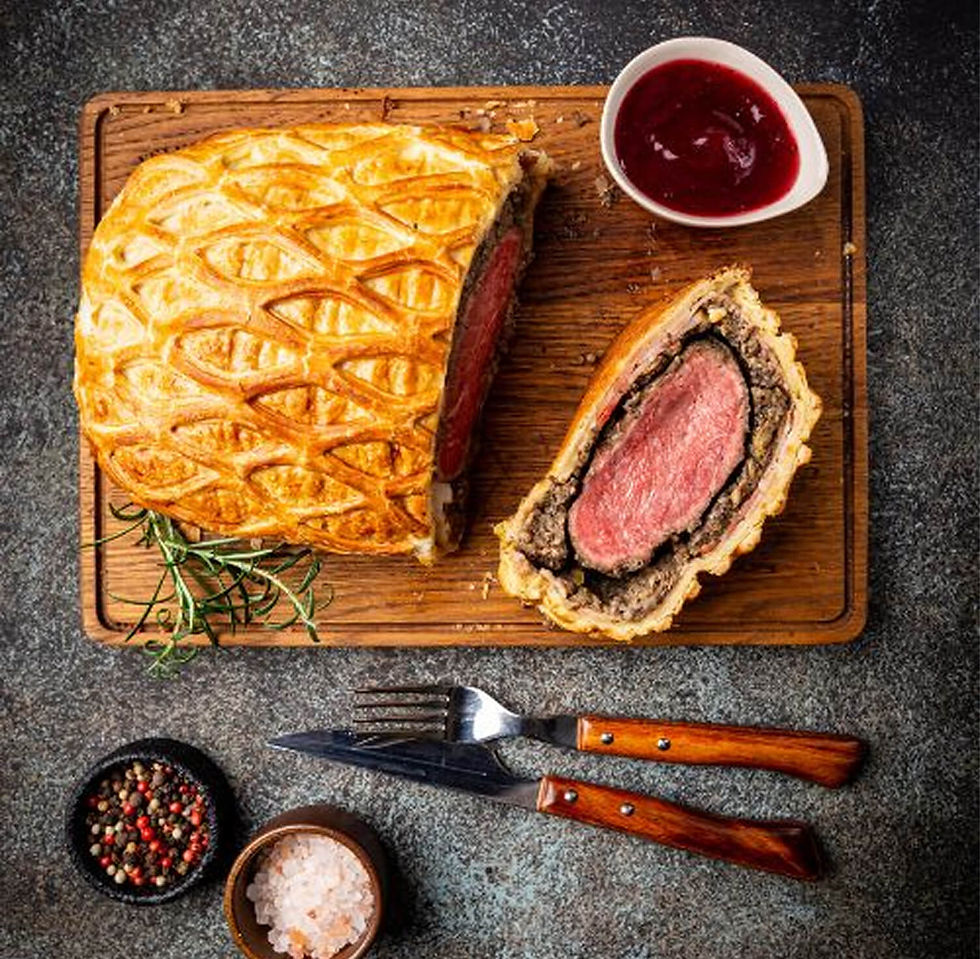
Beef Wellington is a luxurious dish featuring tender beef fillet coated with a flavorful mushroom duxelles and wrapped in a golden, flaky puff pastry. Perfect for special occasions, this recipe combines rich flavors and impressive presentation, making it the ultimate centerpiece for any celebration.
Servings :
4 Servings
Calories:
813 calories / Serve
Prep Time
30 mins
Prep Time
30 mins
Prep Time
30 mins
Prep Time
30 mins


Comments